Golf cart rental
Golf carts and low speed vehicles carry the paperwork burden of a vehicle rental at a fraction of the price point. Bodhisys was built around that shape rather than retrofitted to it.
NO MONTHLY FEE · 4.5% AT CHECKOUT · PAID BY YOUR CUSTOMER

Every rental needs a licensed driver on file, proof of insurance, and a signed waiver, and in most jurisdictions the operator carries the liability if any of it is missing. Collecting that at a counter on a Saturday morning is where the queue forms.
Most fleets in this category are mixed. Beside the course carts sit low speed vehicles: Mokes, GEMs and street-legal carts with a VIN, a plate, seat belts and a 25 mph ceiling, road legal on posted streets under 35. They book through the same flow and rent to the same guest, and they carry a heavier file. A plated LSV needs a driver licensed for the public road, insurance that covers it there, and in some jurisdictions a sobriety check before it moves, where a course cart on private property needs none of that.
One catalogue has to hold both rules, because the operator is not going to run two systems for one lot. Availability, seasonal rates, delivery runs and the fee at checkout are the same. What changes is which documents hold the unit back, and that belongs to the vehicle record rather than to the person taking the booking.
Carts and LSVs also move between properties during a season, so the location record has to keep up with a unit that was at one address on Monday and another by Thursday.
A tracker in the vehicle answers the other half of that question. Where a plated LSV is right now, and whether it has left the streets it is allowed on, comes back as an out-of-zone alert while the vehicle is still easy to reach.
Eight carts, two locations, one in the workshop. Book against each model and see which one can tell you which cart the customer is getting.
The constraint in this category is complete driver documentation before the key changes hands. Everything below is aimed at it.
Reservations land against individual units. Delivery and pickup runs come out of the addresses captured at booking, sequenced into one loop rather than a list of addresses in the order they were booked. Drops are confirmed with a photo and a timestamp. Returns are recorded against the unit that came back, and availability reopens once it is fit to go out.
The first picture below is a real Saturday rather than a drawing of one, with a good part of what the platform does sitting behind that one screen. It works the same way at whatever size you run, from a single van out of one location to a fleet across several. The second picture is that same morning taken apart into a single run.
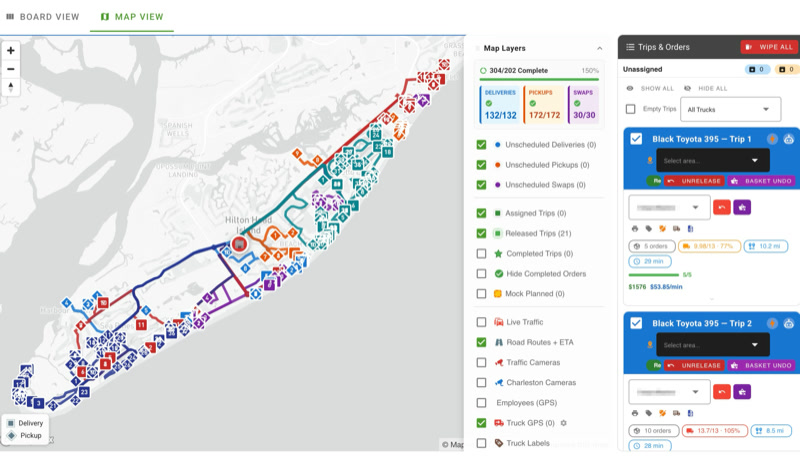
Reading the map
The addresses come off the reservations. The run is built as one loop that turns right out of the depot and right back into it, so no road is driven twice and no stop is passed before its window opens.
What they rent, where they rent it, and which parts of the platform their morning depends on. Their own account of it is underneath, in the words they gave it.
With Bodhisys, we've been able to streamline our entire workflow. The ability to track deliveries, capture vehicle condition photos, and manage guest documentation all in one place has reduced errors and saved our team hours every day. It's brought a level of organization and visibility we didn't have before.
Bodhisys charges no monthly fee. The platform takes 4.5%, added to each reservation and paid by your customer rather than by you.
The savings calculator puts that against what you pay today, including reseller commission and paid modules.
Bodhisys is rental operations software for companies that rent things, vehicles and experiences. It was built for rental inventory rather than adapted from a ticketing system, and it has been in market since 2023.
For golf cart and low speed vehicle rental companies it runs reservations, inventory across every location, routing, delivery confirmation, waivers and returns in one system. The category constraint it is aimed at is complete driver documentation before the key changes hands.
There is no monthly fee. A 4.5% charge is added to each reservation and paid by your customer at checkout.
Bodhisys is younger than FareHarbor and Peek Pro and has a smaller install base. An operator whose revenue is mostly timed tours, or who needs a long list of third-party integrations today, is better served by an incumbent.
There is no monthly fee. A 4.5% charge is added to each reservation and paid by your customer at checkout.
Yes. Customers, future reservations and booking history migrate from FareHarbor, Peek Pro and Bike Rental Manager.
A tour flow sells a seat at a time. A rental flow has to capture what leaves, where it goes, when it comes back and who is responsible for it in between.
Yes. Plated LSVs, Mokes, GEMs and street-legal carts sit in the same catalogue as course carts, on the same availability, seasonal rates, delivery runs and checkout. What changes is the document set that holds a unit back, and that lives on the vehicle record rather than with the person taking the booking.
A plated low speed vehicle carries a VIN, a plate, seat belts and a 25 mph ceiling, and it is road legal on posted streets under 35. It needs a driver licensed for the public road, insurance that covers it there, and in some jurisdictions a sobriety check against the person driving off. A cart staying on private property needs none of that, and the booking flow asks for each of them per unit.
Where a tracker is fitted, yes. The vehicle reports its position while it is out, and a boundary drawn around the streets it is plated for raises an out-of-zone alert to the office at the crossing, while the vehicle is still easy to reach.
Verified against public documentation, 2026-08. Re-check each quarter; these are well-resourced companies that ship.