The busiest day
Nothing breaks on a Tuesday in April. The gaps were there all along, and Saturday is the day volume makes them visible.
On a Wednesday in May a rental operation looks well run on almost any software. Twenty bookings, four deliveries, one return that needs a wash before it goes out again. A manager holds the whole day in their head, and the gaps between the booking tool, the routing app and the spreadsheet never come up because there is time to walk out to the yard and look.
Saturday in July is a different machine. Deliveries, pickups and swaps land inside the same six hours, walk-ups queue at the counter while the phone rings, and two drivers are asking the same question from opposite ends of the island. Every gap that Wednesday absorbed now costs a stop.
Size changes the volume rather than the failure. A Saturday that fills every truck you own breaks in the same places as a Saturday of one van and a short list, which is why the fix is the shape of the system rather than more hands on the day. A system that holds on a Wednesday tells you nothing about either.
One. A unit sold twice, because availability lives as a count and two people drew from it inside the same minute. The second guest finds out at the counter.
Two. A driver doubling back, because the run was built in the order the bookings arrived rather than by zone and time window. Twenty minutes here, twenty there, and the last four stops slide past the window.
Three. A unit on the board that is in the workshop. Nobody moved it, because moving it means editing a spreadsheet that lives on somebody else's laptop.
Four. A delivery nobody can prove. The guest says the chairs never came, the driver remembers the porch, and there is no record either way.
Five. The counter queue, which is paperwork rather than payment. Licences photographed on a personal phone, waivers signed on a clipboard, and a family of five held up while a member of staff types an address.
On a quiet day an operation runs with slack in it. A twenty-minute error gets absorbed by the gap before the next job, so it never becomes a visible failure and never gets fixed.
On a peak day the slack is gone. Vans and staff run close to full utilisation for six straight hours, which means a twenty-minute error does not get absorbed at all. It moves down the day and lands on the last booking, which is the one that gets cancelled, refunded or handed over an hour late with an apology.
That is why the same five failures show up every season on the same day. They are not new problems appearing in July. They are the ordinary friction of the rest of the year, with nowhere left to hide.
Sequence the run the night before, by zone and time window rather than by booking order, and print it. This is worth doing on paper if that is what you have, because the sequence is the part that saves the miles.
Put every unit on one board across every location you run, even if the board is a whiteboard. The failure you are removing is two people drawing from the same pool without seeing each other.
Collect the paperwork before arrival. A licence photographed and a waiver signed on the guest's own phone the night before removes the queue at the counter, and it is the single change most operators feel first.
Photograph every unattended drop, with the address visible in the frame, and send it to the guest while the driver is still on the road. Three days later that photograph is the whole argument.
Make a returned unit unavailable by default. Somebody has to say it is fit before it can be sold again, and the default matters more than the process around it.
The picture below is a real Saturday on Bodhisys rather than a drawing of it. Deliveries, pickups and swaps closed across the island, every route sequenced by window and zone, on the same screen that carries a single van and a short list on a quiet morning.
The loading list comes off the run, the run comes off the reservations, and a unit that is not on the list will not scan into the van. Each stop closes with a photo the guest has before the van reaches the next address, and a returned unit stays off the board until somebody marks it fit.
None of that is exotic. It is the five failures above, each one removed at the point it starts.
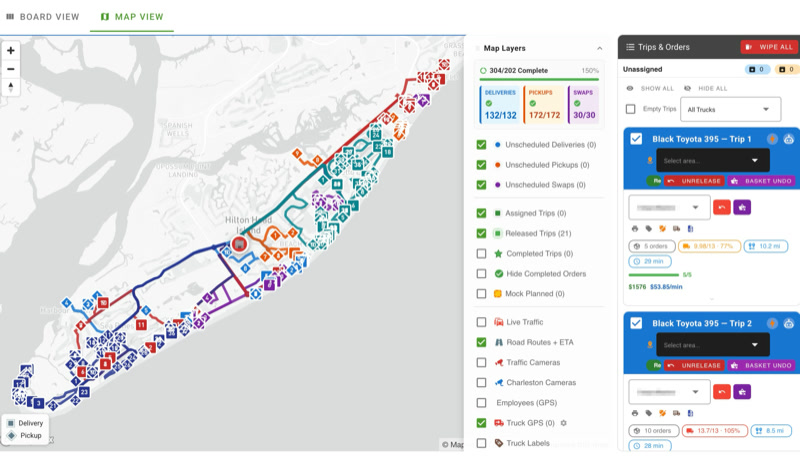
Reading the map
Routing does not add a van. An operation with 300 stops and five trucks on a Saturday has a fleet problem, and the best sequencing in the category will move the failure rather than remove it.
The same is true of the counter. Software takes the paperwork out of the queue, and it does not put a second person on the desk at nine in the morning in July.
Because a peak day removes the slack that hides the rest of the year. Double-booked units, badly sequenced runs, units on the board that are in the workshop, deliveries nobody can prove and paperwork collected at the counter all cost twenty minutes each, and on a quiet day those twenty minutes get absorbed by the next gap in the schedule.
On a peak Saturday there is no gap. Errors move down the day and land on the last bookings, which is where the refunds and the late handovers come from. The fix is to remove the five failures at their source rather than to work harder on the day itself.
Drop time and route density decide it, and the spread between categories is wide. A beach gear round of short unattended drops in a dense zone runs several times what baby gear with assembly on site can manage. Any figure quoted at you by a vendor is somebody else's operation, so measure stops per driver hour across a fortnight of your own and plan against that.
By hand is a large improvement on booking order, and it costs a manager an hour every evening in season. Software takes that hour back and re-sequences when a booking changes at nine at night, which is the case handwork tends to miss.
There is no monthly fee. A 4.5% charge is added to each reservation and paid by your customer at checkout.
A demo takes six fields and someone who understands rental operations calls you back. Where Bodhisys is the wrong fit you will hear it on that call rather than after three meetings.