What leaves the building
A run built in the order the bookings arrived is a route drawn by your customers. They did not book in geographical order.
In most delivery-based rental operations somebody spends an hour every evening with tomorrow's bookings on one screen and a mapping app on another, working out who goes where and in what order.
It is skilled work and it produces a decent run. It also has to happen again when three bookings arrive at nine at night, which is the moment it usually does not happen, and the driver leaves in the morning with a list that is a day old.
Take forty stops in a morning. Sequenced by zone and time window, the average leg between stops might be five and a half minutes. Sequenced in booking order, with the driver crossing back over the same roads, eight is common.
That is 100 minutes of difference on one van on one morning. Two vans and a twenty-week season and you are into hundreds of hours of paid driving that produced nothing.
Those are illustrative figures. The number worth tracking in your own operation is stops per driver hour, and the miles behind them.
Vehicle capacity. A run that looks tidy on a map is worthless if the van cannot carry it, and the discovery happens at the loading bay at seven in the morning.
Deliveries and pickups together. On any real morning a driver is doing both, and planning them as separate lists is what produces the doubling back. A pickup two doors from a delivery has to land beside it in the sequence.
Time windows are the third. A drop before a family wakes up and a collection after a checkout are constraints on the same loop, and a hand-built run tends to honour one of them.
The addresses come off the reservations. The run is built as one loop that turns right out of the depot and right back into it, so no road is driven twice and no stop is passed before its window opens.
Zone the map once, at the start of the season, and put every address into a zone at the point of booking. Most of the gain in sequencing comes from grouping before it comes from ordering.
Build the run from zones and windows rather than from the booking list, and keep deliveries and pickups on one sheet.
Set a cut-off after which tomorrow's run is fixed, and hold late bookings for a second slot. A run that changes at eleven at night without the driver knowing is worse than a run that is slightly suboptimal.
Runs are built from the addresses and time windows captured at booking, with vehicle capacity as a constraint, so nothing is re-keyed into a second application and no run gets built that the van cannot carry.
Deliveries, pickups and swaps are sequenced together on the same loop. The loading list comes off the run, and a unit that is not on the list will not scan into the van.
The picture below is a real Saturday with every route sequenced by window and zone rather than by the order the bookings arrived. The same sequencing runs a single van on a quiet morning, which is where most operations start and where the habit is cheapest to build.
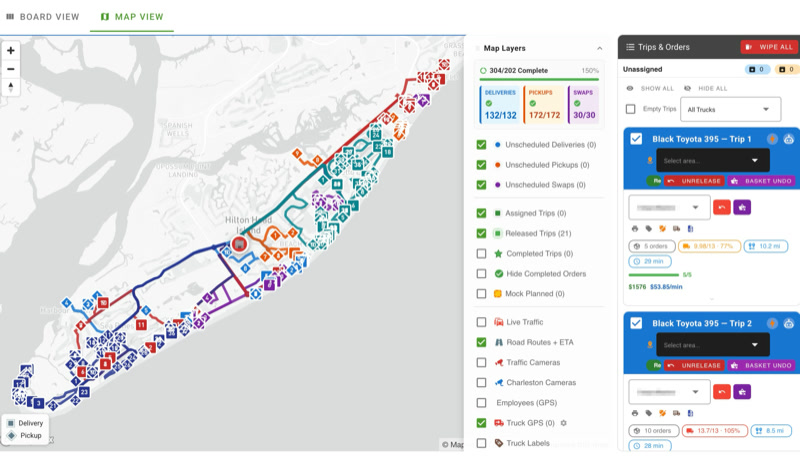
Reading the map
It does no traffic re-routing. A bridge backed up at ten o'clock is still the driver's call, and local knowledge beats a sequence on any island with one road onto it.
It also cannot add a van. If a Saturday needs eight trucks and you have six, sequencing moves the failure to a different stop rather than removing it.
By zone and time window rather than in the order the bookings arrived, with deliveries and pickups sequenced on the same loop and vehicle capacity treated as a constraint. Booking order is a route drawn by your customers, and it is the main source of a driver crossing the same road four times.
The measures worth watching are stops per driver hour and the miles behind them. Bodhisys builds runs from the addresses and time windows already captured at booking, so nothing is re-keyed into a separate routing application.
Yes. An order taken at half past ten is sequenced into a run already halfway through, so it lands in the right place on the loop instead of becoming a second trip at the end of the day.
No. It builds and sequences the run and re-adapts when the orders change. Traffic on the day is the driver's call.
No. Routing is part of the platform rather than an export to a second application, which is where the re-keying and the stale lists come from.
A demo takes six fields and someone who understands rental operations calls you back. Where Bodhisys is the wrong fit you will hear it on that call rather than after three meetings.